Midlife by Design (Part 1 of 2)
How to use design thinking, iteration, and strategic planning to build a better second half
If you’re like me, you’ve reached midlife in a deeply reflective state. You may find yourself constantly looking around at the life you’ve built. The real life. Not what you pretend it is. Not what you imagined it would be. But what it actually is.
When you’re a child, you’re mostly at the whim of your parents, with them controlling your comings and goings. And if you were like me, you looked to adults and idols for any direction you could get on how to live a “good life.” They had the data, after all. The experience and wisdom to guide you in the right direction.
Once you were old enough to have some form of free will, however, your actions, inactions, thoughts, and experiences became the building blocks of the life you’re currently living.
Good, bad, or otherwise, we’ve all been designing our lives whether we were aware of it or not. Of course, forces outside our control help shape that life too. But mostly, the decisions we make play the largest role in determining our outcomes.
Those decisions affect how your family lives, what your career looks like, the body of habits you live by, your home life, your schedule, your perceived reputation, and the set of routines and responsibilities that more or less shape your days.
If we’re honest with ourselves, some of it fits beautifully.
And some of it sure as hell does not.
That is what makes midlife such an interesting season of life. You do not have to just sit in a season of reflection. It can become a season of redesign with true intention.
Because at this point, you have the data. You have the inputs. You have the experience. You have the feedback.
You know what drains you. You know what gives you energy. You know which habits quietly improve your life and which ones slowly erode it. You know which ambitions still feel alive and which ones were probably borrowed from someone else. You know just about everything you need to know about yourself.
The question now becomes:
How am I going to use that information to refine this life?
I like to look at life as something to be designed. And midlife is the perfect opportunity to look at life from the perspective of a designer.
Can design thinking help you redesign your life?
What if you approached this season of life differently? What if you approached midlife like a designer, with curiosity, intention, strategy, and iteration?
Not asking, “What is wrong with me?”
But asking, “What in my life needs a redesign?”
That question has changed a lot for me in my own life. Once I realized that midlife is not something to survive, but something to intentionally redesign, I came to the conclusion that the same design principles used to improve products, services, and experiences can also be used to radically improve a person’s life.
One prototype at a time. One test at a time. Or more simply, one experiment at a time.
Let’s look at how using design principles can help you feel more like the architect of your life and less like a passenger.
Design is a super power
Pretty much the extent of what I’m trying to do with Deliberate.Living can be summed up into two words.
Lifestyle Design.
My goal, after a lot of personal life design, is to experiment with using my skills as a designer to build a business focused on helping you build a life on purpose.
I first heard the term "lifestyle design" in Tim Ferriss’s highly influential book, The 4-Hour Workweek. In the book, Ferriss introduced the concept as a way to create a luxury lifestyle in the present by using time and mobility as currency.
Now, apart from the fact that it is a luxury to even be thinking about designing your lifestyle in the first world we live in, I’m not doing this with luxury in mind. I’m doing it with intention in mind. Choosing the life you lead as opposed to letting your life lead you. Luxury might actually be the trap you need to escape.
Ferriss is not the only person who has explored the idea of designing one’s life or lifestyle. Countless others have pushed similar ideas online.
One of the better examples I’ve come across was from Bill Burnett and Dave Evans of IDEO who wrote another New York Time’s Best Seller. **Designing Your Life: How to Build a Well-Lived, Joyful Life.** In this book, the authors show us how design thinking can help us create a life that is both meaningful and fulfilling, regardless of who or where we are. The same design thinking principles that built amazing technology, products, and spaces can be used to design and build your career and your life.
Design is often thought of as coming up with an idea and creating something from nothing. A spark of inspiration leads to a brand new product never seen before that could possibly change the world.
But in my long career as a designer. It’s looked very different.
I’ve spent the majority of my time iterating on designs of products that already existed. I like to say I’ve spent a career “fixing shitty software”. By continuously iterating and improving a product over time based on data, observations, feedback and testing of new ideas.
That is where we start.
Your life in progress.
You’re not designing a brand new shiny product. You’re tweaking the system you have through small intentional steps.
Design is not just a professional skill. Design is a life skill.
Most people hear the word design and think only of aesthetics. Fonts. Colors. Layout. Branding. A better-looking product.
But design is much deeper than that.
Design is not only how something looks, feels, or works. Design is also a way of thinking.
It is the practice of looking closely at reality, noticing what is working and what is not, identifying friction, questioning assumptions, testing better ways forward, and refining until something fits.
That is just as useful in life as it is in product design.
Most of us are living inside systems we never consciously designed. Our mornings happened by default. Our evenings follow habits. Our health got shaped by convenience. Our attention got shaped by algorithms.
Our calendars get filled with other people’s priorities. Our environments get shaped by accumulated clutter. Even our goals may have been shaped by whatever sounded impressive ten years ago.
Now is the opportunity to redesign that life with more intention and iteration.
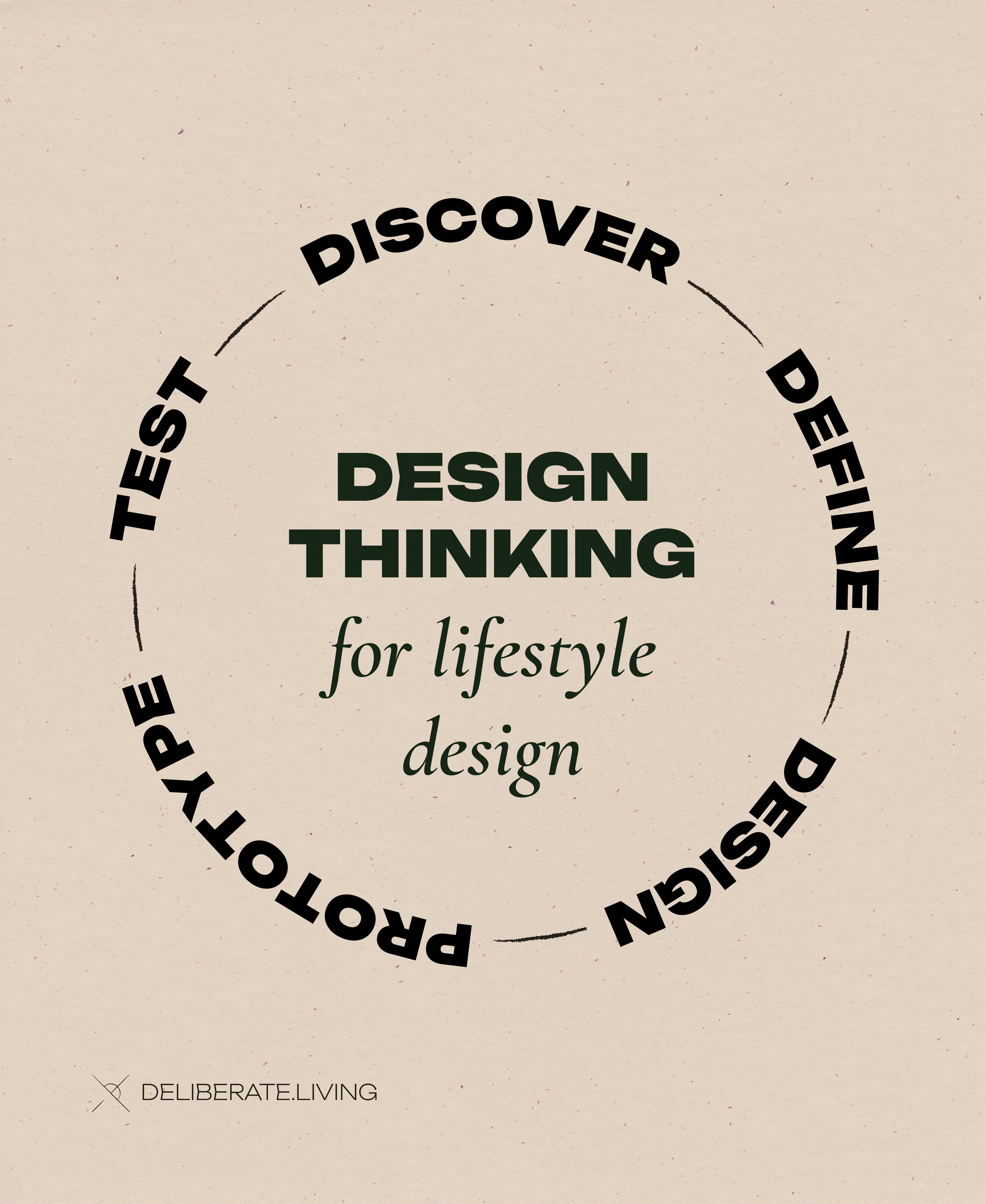
Two popular design methods. Design Thinking and Human-Centered Design roughly follow the same pattern.
DISCOVER: designers assess reality
DEFINE: designers question assumptions
DESIGN: designers eliminate friction
PROTOTYPE: designers prototype solutions
TEST: designers test and refine
That framework is gold for midlife.
Why midlife is the right moment
When you are younger, you’re still discovering yourself. You’re trying things on. Chasing opportunities. Learning through trial and error. Making some good bets and some terrible ones.
That is normal. But midlife gives you something better than raw ambition. It gives you perspective.
You have enough lived experience now to stop pretending. You know which tradeoffs are worth it. You know which parts of success are hollow. You know which parts of your life are life-giving. You know what your body responds to. You know what your marriage needs. You know what your children actually remember.
That is the feedback you need to make informed decisions. That is design data.
And if you are willing to use it, midlife can become one of the most creative seasons of your life.
Not because you are starting over from scratch. But, because you can start refining with honesty. You take the data you have. Mistakes, wins, patterns, desires, and lessons and then you can redesign from truth, not fantasy.
That is what lifestyle design is all about. You have a life, it’s already in progress. You have feedback from a lifetime’s worth of interactions. You have the data. You can iterate yourself to a life that feels more true to you.
You don’t need more inputs. You have enough data to stop guessing.
Here are your steps to get started.
Step 1: Audit your current life
“You take the good.”
What is working? What gives you energy? What lights a fire under your ass? What can you not stop thinking about?
“You take the bad.”
Where is there friction? What feels off? What is draining energy? What no longer fits? What feels heavy? What is misaligned?
“You take them both and there you have. The facts of life 🎶.”
Every redesign starts with reality. Not pretending everything is fine because it looks fine from the outside. Reality.
Where do you feel rushed, drained, resentful, distracted, or out of alignment? What habits keep repeating even though you know they are not serving you? What parts of your schedule no longer fit the person you want to become? What do you keep tolerating that you shouldn’t?
This process isn’t meant to get you upset. You need to observe how you really feel about about the inputs in your life. A designer does not look at a poorly operating experience and make it personal. He studies it.
When something feels off, try to get curious. Why do you feel this way? What assumption are you still living under? What keeps happening that should not keep happening?
That shift alone is powerful. You stop moralizing every problem and start examining it.
Here is a great tool to get down to how you really feel about the areas in your life.
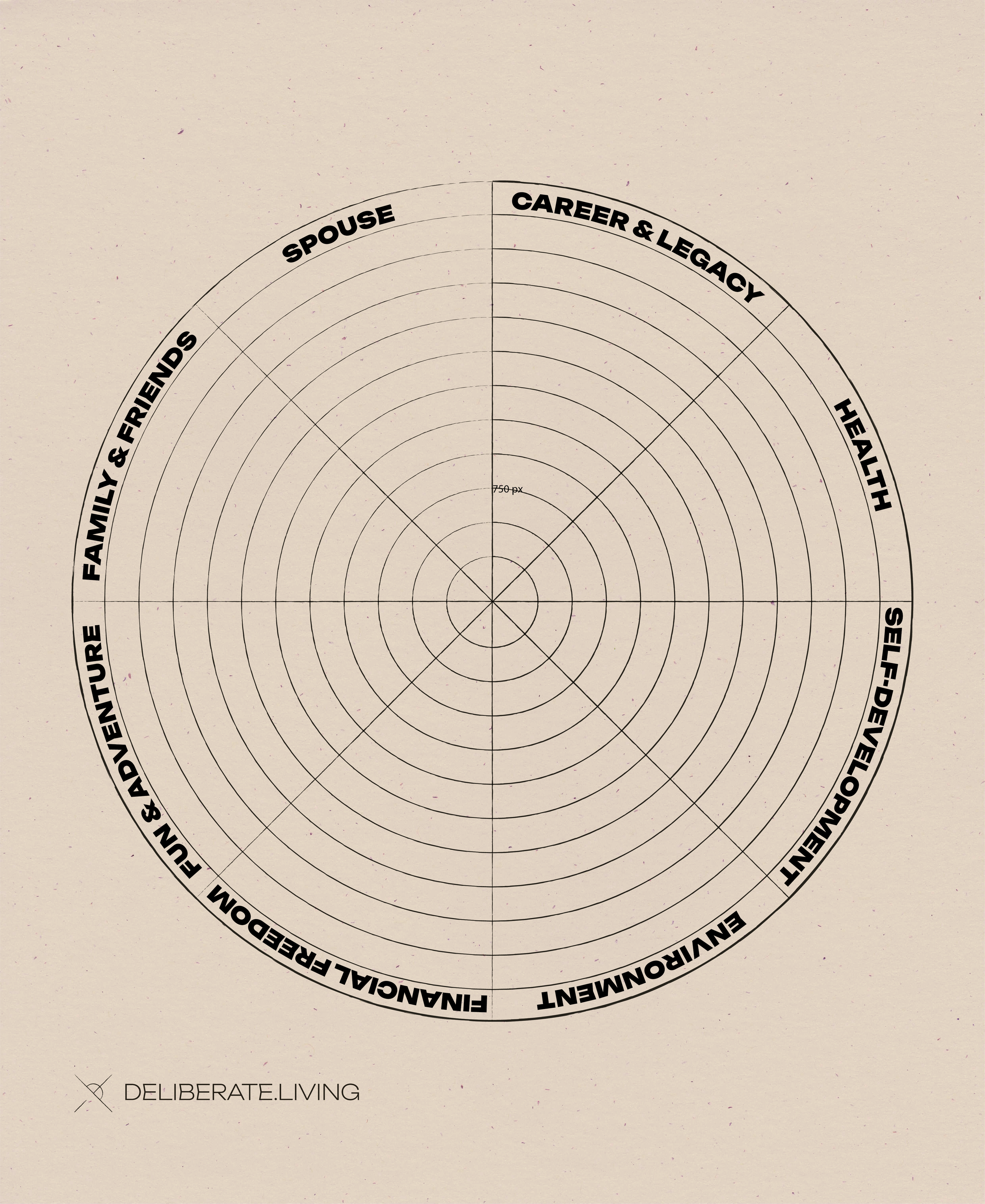
This article is the best explanation I’ve found for running this exercise. Give a number to the level of satisfaction in each area of your life. You’ll find one or two areas may be lacking compared to others. That is where you should start.
Step 2: Clarify what you actually want NOW
What does a better version of life actually look like? What do you want your days to feel like? What matters now? Not what impresses people. What would impress the wiser you?
This is an easy place to get stuck. Chasing a version of life that made sense at 28, 35, or during some earlier chapter in a younger body.
But midlife asks a better question:
What kind of life fits who you are now? What kind of legacy do YOU want to leave? If YOU had only 10 years to live, would YOU live it differently? What do YOU want your days to feel like? Who do YOU want to be surrounded by. What kind of father, husband, creator, leader, or friend are you becoming?
What kind of health do you want to carry into the second half? What kind of work will feel meaningful? What kind of home do you want to build? What kind of pace, energy, and depth do you want your life to have?
Clarity matters because you cannot redesign around a blurry target. A better life is not built from vague adjectives. It gets built when you can see the next version clearly enough to make decisions in its direction.
If you need some direction on clarifying your vision. Start here.
This newsletter discusses how to create your own personal life vision. I think this is the most important start in understanding what you want out of life and where you’ll need to start in the redesign process.
Step 3: Redesign the system, not just the goals
What routines, environments, priorities, and rules need to change?
This is where design thinking becomes life-changing. Most people set better goals without redesigning the system around them.
They say they want:
better health
deeper family connection
more creative work
less distraction
more peace
more adventure
stronger finances
But they keep the same calendar. The same environment. The same phone habits. The same evening routine. The same stress loops. Without changing the inputs, you end up with the same defaults.
That rarely works. If you want a different outcome, the system has to change.
Maybe the redesign is in your mornings. Maybe it is in your sleep. Maybe it is in your habits between those hours.
Maybe it is in how often your phone is in your hand. Maybe it is in what your family time actually looks like. Maybe it is in the standards around your work, your body, your money, or your attention.
A better life usually does not arrive through one heroic decision. It arrives through better-designed systems.
Step 4: Prototype the next version
The single most useful lessons design has given me. Prototyping.
A prototype is an early model of a design to test the concept or process. It is used in evaluate the design solution and gather feedback before final implementation.
You do NOT need to completely reinvent your life. You just need to run small experiments to see if the change fits.
Try waking up earlier for two weeks. Try building a weekly reset night. Try deleting the apps that always wreck your focus. Try a different training split. Try planning family time with more intention. Try working from a clearer seasonal focus instead of chasing everything all at once.
Some things will work immediately. Some will be abject failures. Some will partly work and need adjustment. That is fine. Iteration is not failure. Iteration is intelligence.
One of the scariest things about change and what stops people from redesigning their life is that they think every change has to be permanent, public, and perfect. It does not. You are allowed to test. You are allowed to refine. You are allowed to build the next version of yourself gradually.
You do not need a complete reinvention overnight. You need to prototype and test.
Step 5: Iterate toward alignment
What makes design powerful is not just creativity. It is feedback. You look at what happened, tell the truth about it, and improve from there.
That matters in life too. What worked this month? What gave you more energy? What made your home feel better? What habits made you feel stronger, calmer, or more focused? What experiments were completely unrealistic? What still feels cluttered or off? What needs simplifying?
The point is to stay in conversation with your own life. To keep noticing, refining and aligning your days with what matters most.
That kind of honesty is rare. It is also one of the greatest advantages you can build in midlife.
One thing this process produced for me
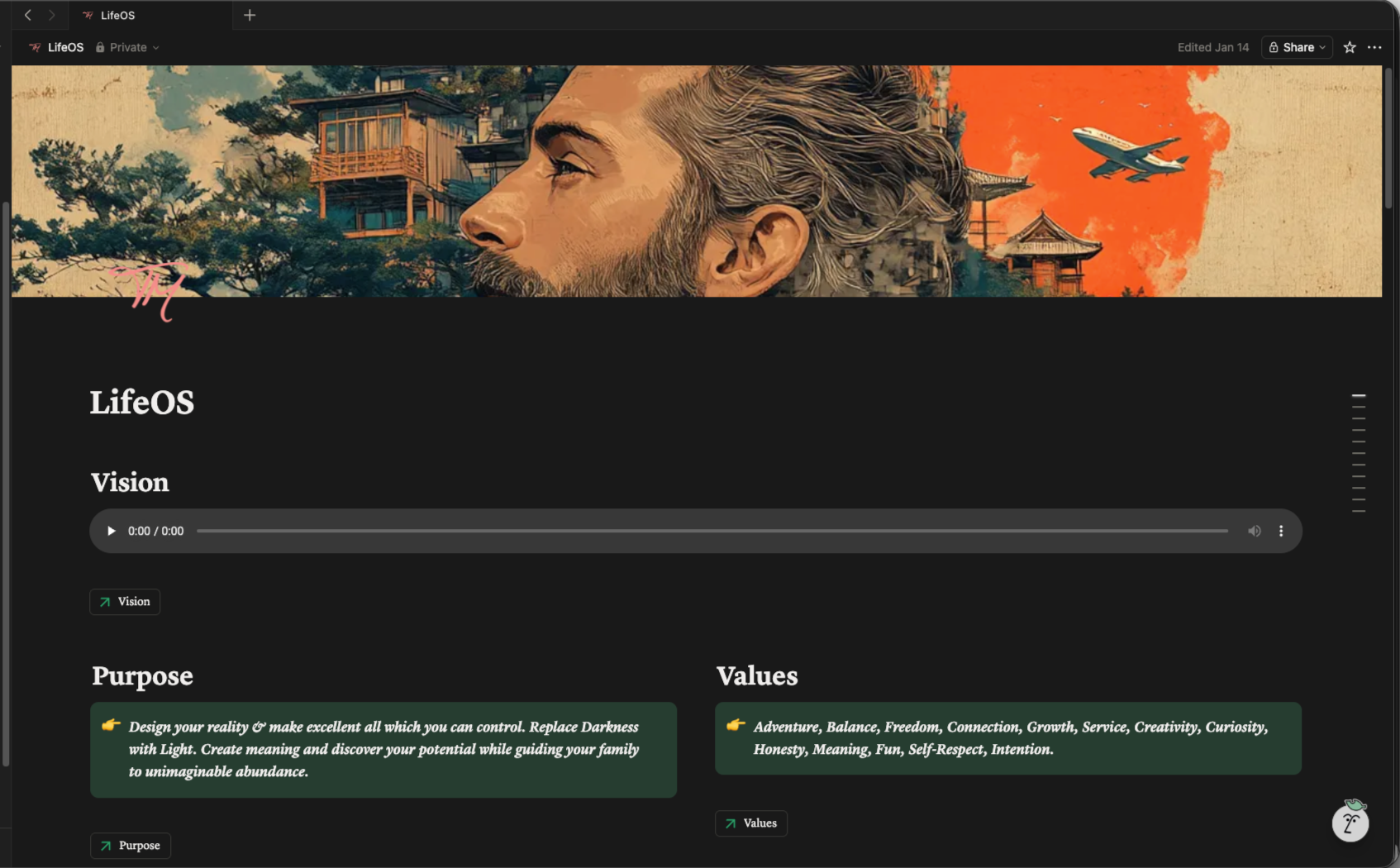
Over time, this way of thinking led me to build a personal system I call LifeOS.
Not because I wanted another productivity tool. Because I wanted one place to hold the deeper structure of my life.
My vision.
My values.
My mission.
My long-range plans.
My current season.
My daily rhythm.
My project priorities.
It is not magic.
It is just a practical result of asking a better question: If I were designing my life more intentionally, what would I need to keep visible?
That question keeps leading somewhere useful. Not just toward more output, but towards more alignment.
I’m working on cleaning up this template to share with you all. I’ll release it part 2 of this blog post. You can take it or leave it. Make it your own. Make updates. I searched for a long time for a place to store my life’s plan and thoughts. Notion just seems to be the best place to do that. And all the other templates I’ve used or looked at were just to darn complicated to live with.
I hope this dashboard will bring you as much clarity as it has for me.
A better life is not found. It is designed and refined through experiments.
The goal of this process is not to become someone else. It is to build a life that fits who you are now. The goal is also not to optimize yourself into a machine. Nobody wants to live that life.
The goal is to live with more clarity, energy, and intention.
I think a lot of human suffering comes from living in misalignment. Misalignment with our value. Our attention going to things we don’t even respect. Saying you want to live one life while staying solidly put in another.
That disconnect creates tension.
And if it goes on long enough, people start looking for ways to escape it. More noise. More stimulation. More spending. More food. More scrolling. More fantasy.
Maybe the answer is designing a life that feels better to fully inhabit. A life with structure. A life with purpose. A life with space for health, love, work, play, growth, and meaning.
A life where your days reflect your values. A life where the future is being shaped on purpose.
That is what I wish for you. Not a perfect life. A deliberate one. You are the designer of your days.
Part 2 coming soon.
“Fare thee well now
Let your life proceed by its own design.”
T.A.M.